







18 June 2026 · 7 min read · Site Admin
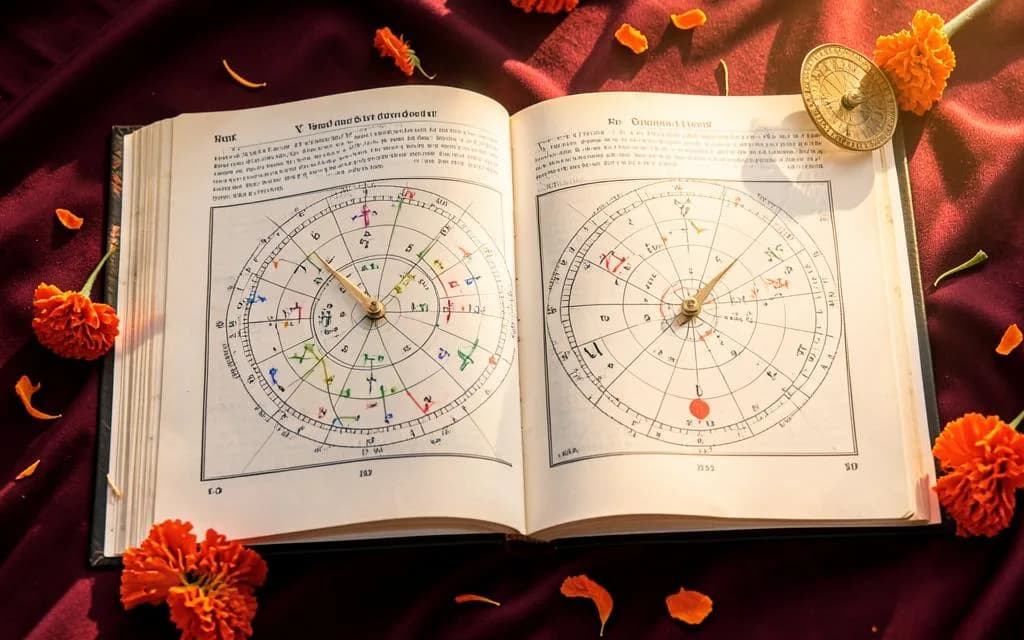
Rahu and Ketu attract more anxiety than any other part of a birth chart, and most of it comes from being told what they mean rather than how they work. They are worth understanding directly, because the mechanism is not complicated and knowing it makes a great deal of what you will be told about them easy to assess.
They are points, not bodies
The Moon's orbit is tilted against the plane on which the Sun appears to travel. Those two paths cross at two points, and those points are Rahu and Ketu. There is nothing there to see: no body, no mass, only a geometric intersection that happens to be where eclipses occur.
That origin explains a great deal about how the tradition treats them. They are described as shadows, they are assigned no rulership of a sign in the classical scheme, and they always sit exactly opposite one another. They also move backwards through the zodiac, completing a circuit in about eighteen and a half years.
Why they are read as one axis
Because the nodes are always opposite, they are never really read separately. Whatever Rahu is doing in one house, Ketu is doing its counterpart in the house across from it, and the useful reading is about the relationship between those two areas of life.
The traditional characterisation is straightforward enough. Rahu amplifies: it produces appetite, curiosity, and a pull toward whatever is unfamiliar in the affairs of the house it occupies. Ketu does the reverse: it produces facility without interest, competence that was arrived at without effort and does not hold attention.
- Rahu shows where a life reaches outward, often past what is comfortable
- Ketu shows where something comes easily but fails to satisfy
- The two are always in opposite houses, and read as one statement
- The axis completes a full circuit in roughly eighteen and a half years
The parts that are usually skipped
A placement is the beginning of the analysis rather than the end of it. Three further factors determine how the axis actually behaves, and a reading that omits them is not saying much.
The first is the dispositor: the lord of the sign each node occupies, whose own condition colours the node considerably. The second is the nakshatra, which is frequently more informative than the sign. The third, and most important practically, is the dasha — because a placement that is quiet for thirty years can become the organising feature of a life when its period arrives.
On the fear
A great deal is sold on the back of these two points, and the selling relies on their reputation rather than on anything in your chart. It is worth remembering that everyone has them, that they sit in some house for everybody, and that a configuration common to a large share of the population is not by itself a catastrophe.
Read as a map rather than a sentence, the axis is among the more useful things a chart contains. It tends to describe, with unsettling accuracy, what a person has been chasing and what they have been quietly putting down.
Personal charts need personal interpretation.